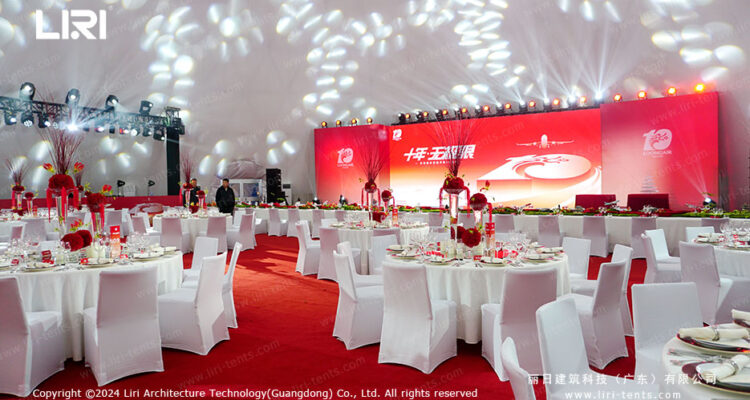
A geodesic dome tent does something no other wedding structure can. The curved frame and transparent panels create a 360-degree view of whatever is outside — trees, stars, hills, ocean. It feels less like a tent and more like a glass observatory dropped onto your venue.
I walked through one at a beach wedding in Cornwall last August. The couple had set it up 30 meters from the water. Inside: 80 guests at round tables, a small stage for the band, and a bar in the corner. Through the PVC panels you could see the sunset turning the sea pink. Nobody was checking their phone.
What the Dome Actually Looks and Feels Like
The structure is half a sphere — picture a golf ball cut in half and scaled up to 10 or 15 meters across. The frame is either steel or aluminum tubing arranged in triangles. The covering is PVC fabric, often with transparent panels in alternating sections. Some domes are fully clear on top with white lower sections.
Unlike a clear top wedding tent, which has flat vertical walls and a peaked roof, the dome curves from the ground up. This means every guest has sightlines to the outside, not just those near the walls. It also means you have less usable floor space near the edges because the walls slope inward. Plan your layout around that.
Why Venue Owners Are Adding Domes to Their Fleet
The wedding tent rental market has been growing steadily for years. According to the American Rental Association, event tent rental revenue in the US passed $2 billion in 2023, with specialty structures like domes and clear-span frames driving most of the growth.
A geodesic dome wedding tent sits at the premium end of that market. Couples pay a premium for the look — typically 30-50% more than a standard frame tent rental. But the tent itself costs roughly the same to buy. That margin is why more rental operators are adding domes to their inventory.
Setup Reality Check
Domes are not the easiest tent to pitch. A 10m-diameter dome takes a crew of six about five to six hours with experience. The triangular frame sections bolt together in a specific sequence — skip a step and nothing lines up. PVC panels zip or clip into place after the frame is complete.
For a wedding, you need a full day for setup. That means the dome goes up the day before the event. Factor that into your venue access and labor costs.
The good news: once assembled and anchored, a geodesic dome is extremely stable. The triangle structure distributes wind load evenly. In manufacturer testing, properly anchored domes withstand 90-100 km/h winds without damage.
Making It Comfortable for Guests
A clear dome traps heat — think of a greenhouse. On a sunny summer day, the interior can get 8-10°C warmer than outside. Solutions:
- Leave the entrance flaps open for cross-breeze
- Add portable air conditioning (one 5-ton unit handles a 10m dome)
- Choose a dome with opaque roof panels if your wedding is in a hot climate
On the flip side, domes hold heat well at night. One couple we spoke to hosted a March wedding in a dome tent in Scotland. Two industrial heaters kept the interior at 20°C while it was 4°C outside. The transparent roof let guests watch snow flurries during dinner.
What It Costs (Ballpark Numbers)
Manufacturer-direct pricing for a 10m-diameter PVC geodesic dome with transparent roof panels runs roughly $8,000-15,000. Larger 15m domes range from $15,000-28,000. Add flooring, lighting trusses, and climate control, and your total setup investment can reach $20,000-40,000 for a complete package.
For rental operators, the payback period is typically 12-18 months at 25 bookings per year. For couples renting, expect to pay $2,000-5,000 for a weekend depending on size and location.
Frequently Asked Questions
What size geodesic dome do I need for my wedding?
A 10m-diameter dome fits 60-80 guests for a seated dinner with a small dance floor. A 12m dome handles 80-100. A 15m dome fits 120-150 comfortably. Remember that the curved walls reduce usable floor area — plan for roughly 15% less space than a rectangular tent of the same width.
Can a PVC geodesic dome handle heavy rain?
Yes. The PVC panels are waterproof with heat-welded seams. The dome shape naturally sheds water — nothing pools on top. The main concern is drainage around the base. Set the dome on slightly elevated ground or add a perimeter drainage channel if your site tends to get soggy.
How do you decorate a geodesic dome for a wedding?
The frame itself is the decoration. Most couples add fairy lights along the triangle edges, a central chandelier hanging from the apex, and fabric draping between sections. Less is more — the structure is already dramatic. Avoid heavy hanging decor that adds load to the frame joints.
Is a dome tent suitable for winter weddings?
Yes, with heating. The dome shape holds warm air efficiently because heat rises to the apex and circulates back down the curved walls. Plan for 3-5 kW of heating per 30 square meters. Add insulated floor panels to stop cold from seeping up through the ground.
How long does a PVC geodesic dome last?
With proper care, 15-20 years. The aluminum or galvanized steel frame has no parts that deteriorate. PVC panels need cleaning twice a year and should be stored dry during off-seasons. Replace panels roughly every 8-10 years depending on UV exposure and usage frequency.