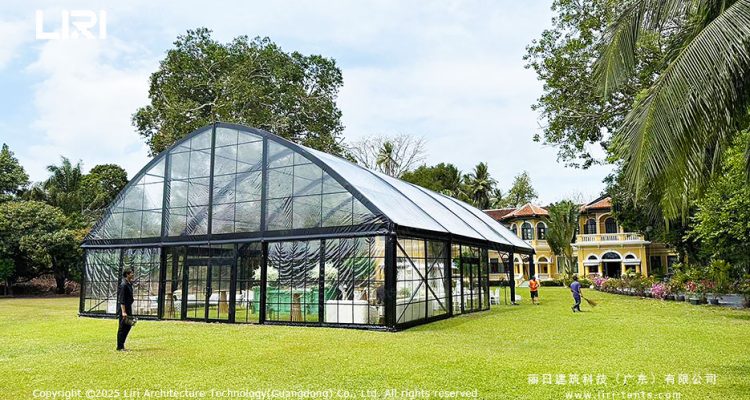
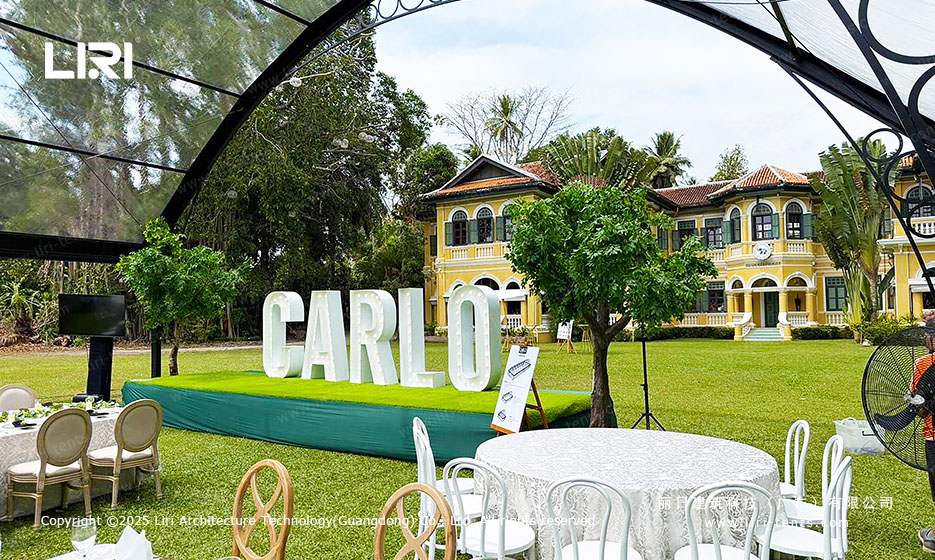
A white-sand shoreline, rows of palm trees, and a historic colonial mansion in the distance — this resort in Phuket knows how to frame a wedding. At the center of it all sat a black-framed transparent marquee, designed to let the tropical landscape do most of the decorating.
The Structure Behind the Scene
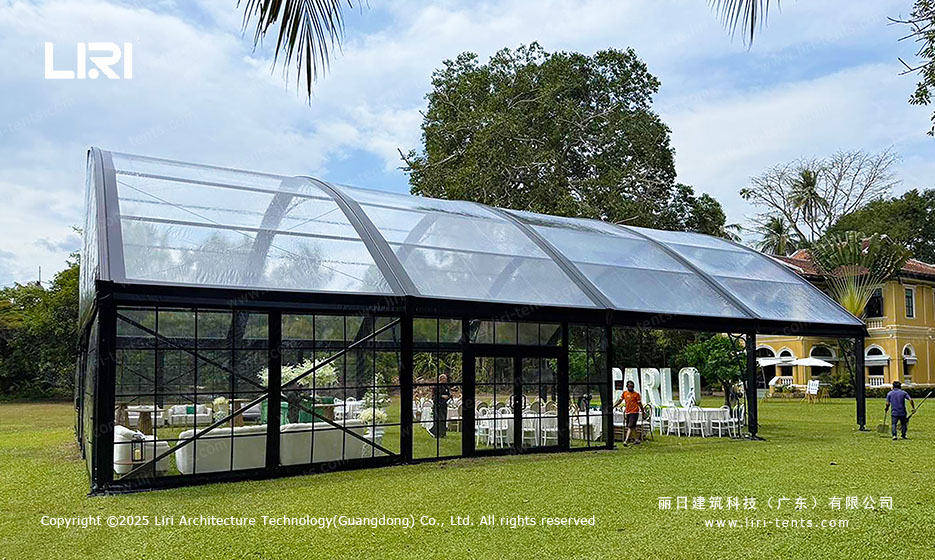
The tent on this project spans roughly 15 by 20 meters, built on a lawn that stretches toward the beach. Its frame is a black powder-coated aluminum arch system — sturdy enough for coastal wind loads, yet slim enough to keep sightlines open. The roof and walls use transparent panels that bring the outdoors in without exposing guests to humidity or sudden rain.
What sets this apart from a standard marquee is the ornamental detailing at the gable ends — decorative black metal filigree that echoes the colonial architecture of the resort’s main building. It reads as part of the property, not a rental add-on. For venues evaluating an orangery-style wedding tent, this is what a well-integrated installation looks like — architectural, not temporary.
Inside the Tropical Wedding Setup
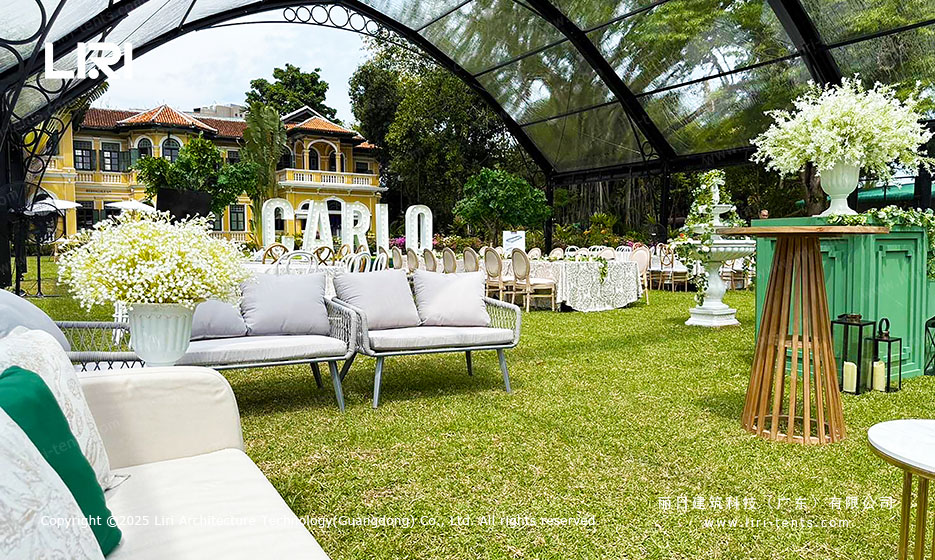
Step through the entrance and the first thing you notice is how the transparent roof curves overhead, tracing the same sweep as the palm fronds outside. Natural light fills the space during the day. At night, string lighting and chandeliers take over, reflected in the clear panels above.
The layout on this occasion was a single long banquet table running the length of the tent. White floral centerpieces alternated with glass candelabras. White Chiavari chairs lined both sides — simple, clean, and deliberately understated against the lush green backdrop visible through every wall panel.
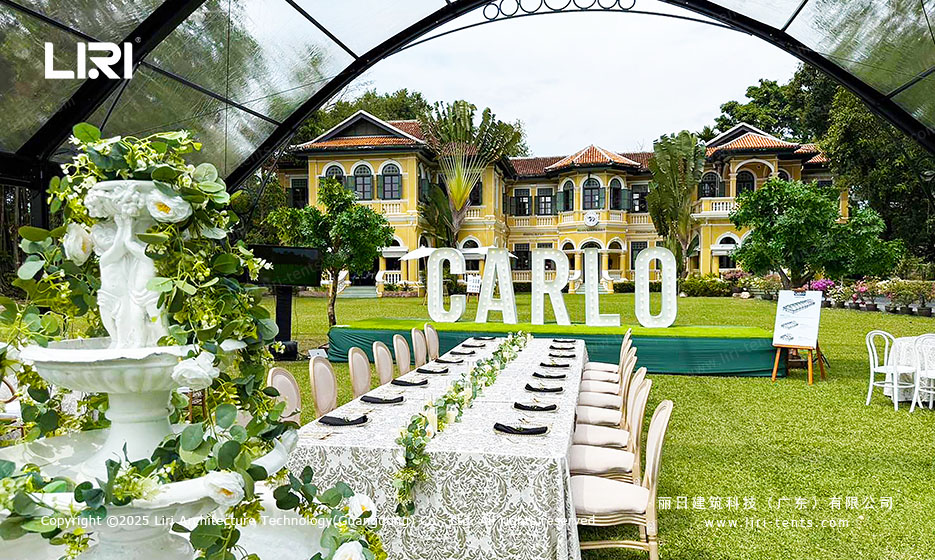
A setup like this works because the tent itself becomes the room. There is no heavy drapery, no fabricated ceiling — just the sky and the foliage doing what they do. Air conditioning units, tucked discreetly along the sides, keep the interior at a steady temperature even when the tropical sun is at its peak. Think of it as a luxury wedding marquee minus the visual weight — transparent, light, and open on all sides.
Why a Clear-Arch Design Works for Beach Venues
Coastal locations come with a specific set of demands. Salt air accelerates corrosion on untreated steel. Afternoon gusts can turn flimsy structures into liabilities. And the heat — relentless in places like Phuket — means any enclosed tent without climate control becomes unusable after 10 a.m.
The black aluminum frame on this installation handles all three. The alloy resists salt corrosion far better than steel. The arch profile sheds wind rather than fighting it. With transparent walls, the tent traps less solar heat than an opaque canopy would — especially once you add AC units along the perimeter. For resort operators comparing options, an aluminum frame tent at a beach venue is not a luxury — it is the difference between a structure that lasts and one that rusts through in two seasons.
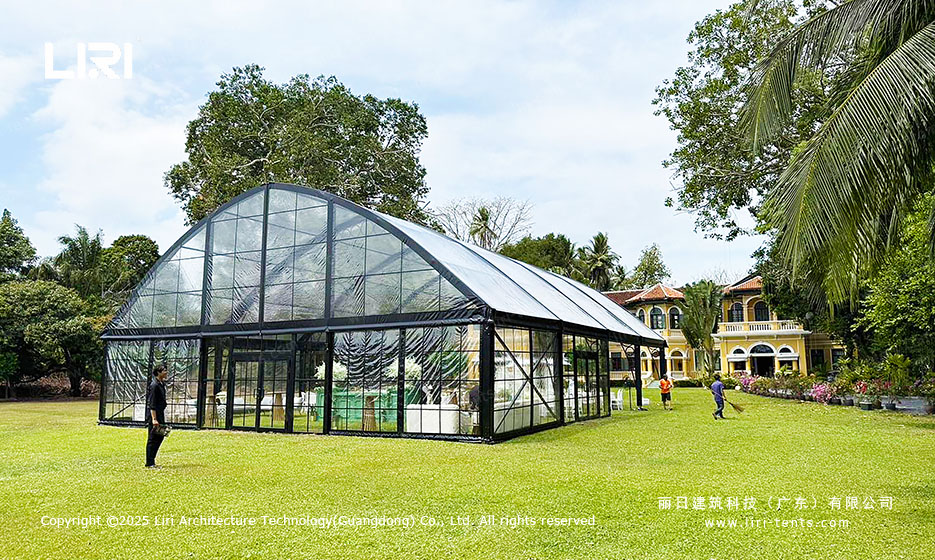
From a planning perspective, the tent sits on grass without a permanent foundation. That is a meaningful detail for resorts that rotate event spaces or operate on leased land. No concrete. No anchors that scar the lawn. Just a clean setup and a clean teardown.
For couples planning a destination wedding at a resort like this, the tent becomes the ceremony backup, the reception hall, and the dance floor — all in one structure. One tent. Three functions. The colonial mansion in the background — a restored heritage building — served as the cocktail and photo area, but the real event happened under the marquee.
What a Venue Operator Should Look For
If you manage a resort or an event venue near the coast, the tent itself is only half the equation. The other half is whether the supplier can deliver a turnkey installation — frame, panels, flooring, climate control, lighting rigging — without you having to coordinate five different vendors.
Ask these questions early:
– Does the frame use aluminum or steel? Coastal environments demand aluminum.
– Are the panels UV-treated? Transparent panels without UV coating yellow within two seasons.
– Can the tent be anchored on grass without permanent footings?
– What is the lead time for a custom span — say, 20 meters?
The tent in these images came from a manufacturer that specializes in aluminum frame structures for events and hospitality. The same team handled the structural drawings, the installation crew, and the post-event dismantling — one point of contact from design to teardown. For venue buyers researching permanent or semi-permanent installations, browsing outdoor wedding tents gives a useful overview of what the market currently offers across different frame types and sizes.
FAQ
How does a clear-arch tent handle tropical rain?
The arch shape naturally channels water off the sides. Combined with integrated guttering along the eaves, the structure handles monsoon-level downpours without pooling on the roof — a common failure point for flat-topped marquees.
Can a beach wedding tent be customized for different resort layouts?
Yes. While this installation uses a 15-by-20-meter footprint, the modular frame system scales up or down — much like a clear span wedding tent that can be configured for different site dimensions. Some venues use a series of connected beachfront marquees — one for the ceremony, one for dining, one for the bar — linked by covered walkways. The gable ornamentation, panel transparency, and frame color are all specifiable before production.
Is a transparent-roof tent too hot for a daytime wedding?
Not if it is paired with climate control and ventilation. The transparent panels reflect a portion of infrared while letting visible light through. With properly sized AC units — calculate roughly 1 ton per 10–12 square meters for tropical zones — a clear-roof tent stays comfortable even in direct sun. Many planners schedule the ceremony for late afternoon and let the sunset do the lighting work.
A wedding tent on a tropical beach is not shelter — it is the frame around the memory. Get the structure right, and everything inside it — the flowers, the table settings, the music — looks twice as good. Get it wrong, and your guests notice the heat before they notice the view.
If you are evaluating wedding tent products for a resort venue or a standalone coastal event, look at the frame material, the panel quality, and the installation track record before you look at the price. A tent that survives one monsoon season is cheap. A tent that still looks new after five — that is the one worth buying.
—
For a beach venue brief, use the Wedding Tent Planning guide to map the site and guest flow, then compare wedding tent price factors before finalizing your structure and accessory requirements.