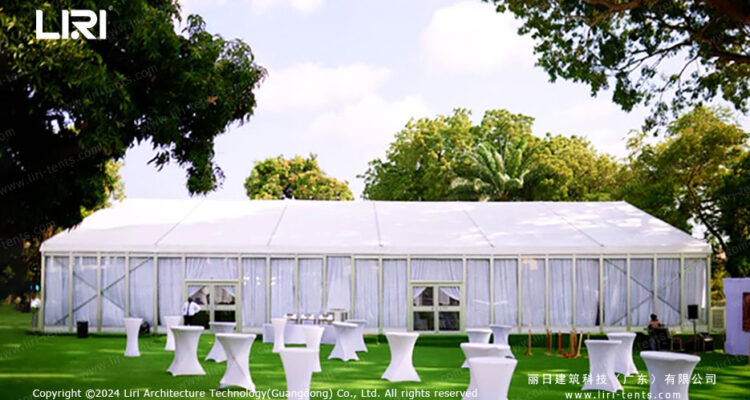
When Mia and David planned their vineyard wedding in Temecula, they had one non-negotiable: no center poles. They wanted long banquet tables running the length of the tent, a clear sightline to the head table, and room for a six-piece band. Their rental company suggested an aluminum frame tent. It worked exactly as promised.
Aluminum frame tents are the workhorses of the outdoor wedding world. They are not the fanciest option — no geodesic domes, no clear roofs — but they get the job done reliably, affordably, and without surprises. If you need a tent that just works, this is probably your answer.
No Center Pole Means Total Layout Freedom
The defining feature of an aluminum frame tent is right in the name: a free-span aluminum frame with no interior support poles. You get one wide-open rectangle of space. Want round tables for 200? Done. Need a long runway aisle down the middle? Easy. A stage for the band, a buffet line on the side, and a dance floor in the center? All of it fits because nothing is in the way.
Compare that to a pole tent, where support poles slice the room into awkward zones. With an aluminum frame, you design the layout first and let the tent conform to it — not the other way around.
Built for Weather, Not Just Looks
The frame is extruded aluminum — light enough to transport but strong enough to handle wind gusts that would flatten a cheaper canopy. The roof and sidewall fabric is PVC-coated polyester: waterproof, UV-resistant, and fire-retardant per industry standards.
Sidewalls can be solid, windowed, or completely removed depending on the weather. On a mild evening, roll up the walls and let the breeze through. If rain threatens, drop them down and seal the perimeter. The tent adapts minute by minute.
Customization That Actually Matters
Color is the easiest starting point. White is the default for weddings, but ivory, champagne, and even soft gray are available from most manufacturers. The frame itself can be powder-coated — white for a clean look, black for a modern contrast, or raw silver for an industrial edge.
Inside, you can add:
– Lining and draping across the ceiling to soften the structure
– Hard flooring — wood-look panels or carpet — so heels don’t sink into grass
– Lighting rigs mounted directly to the frame crossbars
– Glass walls and doors on one or more sides for a more permanent venue feel
Who Should Choose an Aluminum Frame Tent?
If you are getting married on a lawn, at a private estate, or at a venue that lacks a built-in banquet hall, an aluminum frame tent is the most straightforward solution. It costs less than a geodesic dome tent and sets up faster than a large tipi tent. For venues or rental businesses that host weddings regularly, buying an aluminum frame tent outright often pays for itself within a season or two.
Common Questions
What size do I need for 150 guests?
A 20m x 30m frame tent comfortably seats 150-180 guests with round tables, a buffet, a dance floor, and a small stage. Talk to your rental company about a floor plan before booking.
Can aluminum frame tents handle wind?
Yes. Quality aluminum frame tents are engineered for winds up to 80-100 km/h when properly staked and weighted. Always confirm wind ratings with your supplier for your specific location.
How long does installation take?
A crew of four can set up a mid-sized frame tent in a day. Larger setups with flooring, lighting, and glass walls may take two to three days.
Do I need a permit?
Probably. Most municipalities require a tent permit for structures over a certain square footage. Your rental company should handle this, but ask early — it can take weeks.
Is the aluminum frame reusable if I buy it?
Absolutely. Aluminum frames last for years with minimal maintenance. That is why so many venues and rental houses invest in them rather than leasing repeatedly.
Need an aluminum frame tent for your wedding? Get in touch — we will help you size it, spec it, and ship it.